
I'm volunteering at the American Association of Museums (AAM) Conference this week and I've had the chance to enjoy some really interesting sessions. One such session was On the Road: Ephemeral Exhibits and the Visitor Experience. It was all about the emergence of transient exhibits in museums and the "pop-up" museum trend. The discussion was lively and as someone without a museum studies background, some of the theory was hard to follow, but since the talk I've been mulling over the idea of impermanent exhibitions and the concept of the temporary museum.
Each of the panelists were curators of transient exhibitions and museums including FAX at the Drawing Center of New York, the McCormick Freedom Project of Chicago, the Denver Community Museum, and the Torrance Art Museum of Los Angeles. Through discussion of their exhibits and museums, the panelists gave us insight into their own reasons for exploring the medium of pop-up museums and exhibitions.
One of the most valuable aspects of the transient exhibition is its ability to empower visitors and curators alike. The experience of visiting a fleeting exhibit experience is a lot like buying a limited edition print or attending an exclusive small-venue concert: you are one of only select number of buyers or visitors or concert-goers and as a result, you become a special person. The transient exhibit also offers transparency to visitors as the exhibit process unfolds in front of them. They can witness the full life-cycle of the exhibition: from creation, over change, through disassembly. From a curatorial standpoint transient exhibitions can be freeing. They can be a way to take on risk in an isolated window of time and if done independently, a curator can take on full creative control and bypass lengthy approval processes.
Interestingly enough, I heard more skepticism of the exhibition style from some of the presenters themselves. Some of the complaints against the medium cited a lack of history-making, catering to short attention spans, and bringing the museum experience to people who don't want it to begin with. I'm glad these concerns were raised because they're important questions to ask when creating such an exhibit.
More and more, contemporary artists are expressing a need for venues to show work that changes over time, is added to or taken from by visitors, or simply has a limited lifespan. It can cause a museum some anxiety to have to deal with that kind of ephemeral art, especially since museums have always been dedicated to preservation and conservation. And it's fair to worry about the legacy of these pieces if we can't add them to our permanent collections. In response to this, the Torrance Art Museum has decided not to keep a collection at all and effectually all exhibitions are of the pop-up variety. Even without a policy of non-collection, some of that fear of impermanence can be alleviated with an ever-widening range of ways to record transient experiences. After all, performance artists have been making their work permanent with video and photography since the invention of film. Likewise, temporary museums that have come and gone, like the Denver Community Museum, live on in website form with photos of exhibitions and details about the location and mission.
I understand the concern that these transient exhibits might be riding the trend of catering to over-caffeinated, over-extended, focus-lacking multi-taskers. That said, as long as the vision is not compromised and delivers an experience that meets the long-term mission of the museum, it’s less like enabling and instead giving more entry points to an institution. Offering a variety of ways to access a museum can be one of the most welcoming things an institution does.
Museums argue over audience-expanding initiatives all the time. Many include in their missions that they hope to engage new under-represented community members and expand their visitorship. At the same time, there also exists the mentality that if people want to go to museums, they’ll go and that it’s our bias as museum professionals that everyone should be interested in what interests us. My response is this: not everyone will want what we offer, but let’s give as many people as possible an personal invitation to see for themselves and make better informed decisions about their own interests. By placing temporary exhibits or mobile museums in public spaces, they become ambassadors to the museum experience. People who don’t think they belong in museums have the opportunity to change their minds if they find themselves running across a museum unexpectedly.
The concept of the temporary museum has really inspired me and I’m considering creating one of my own in the near future. At the very least, I’ll be doing more research and seeking out examples in my area. One such museum that I'm looking forward to exploring is the SF Mobile Museum and I hope to participate in their next exhibit challenge. If you know of museum popping up in San Francisco soon, please do let me know!
Monday, May 24, 2010
Saturday, May 8, 2010
how we use museums: the RISD museum of art vs. RISD's nature lab
Update: this post has been re-worked and re-published as a guest post on Nina Simon's blog, Museum 2.0
Should a museum be a destination or a place for everyday use? Why don't we use museums the way we use libraries? Nina Simon posed these provocative questions at her presentation and book signing I attended at JFK University last Thursday.
Putting aside the obvious answer to the question (because libraries are free and museums have entrance fees) I began to think more deeply about this museum-library binary. Do I use museums the same way I use libraries? Do I even want to use a museum like a library? I immediately recalled a phenomenon I witnessed as a student at the Rhode Island School of Design.
The Rhode Isla nd School of Design was established in 1877 alongside its Museum of Art intended as a resource for students. The Museum hosts collections directly related to the majors offered at the school, including painting, sculpture, and decorative art and design. The Edna Lawrence Nature Lab, was established in 1937 also as a resource for students. Instead of works of art, the Nature Lab offers taxidermy specimens, bones, seed pods, and other natural items. Both buildings are located within whispering distance of one another at the heart of the city-scattered campus. Both are free for students. Both consider themselves museums with curators, a collection, and a similar mission. And yet, the Museum of Art is often overlooked or dismissed outright by students and the Nature Lab is cherished and spoken of fondly.
It was always obvious to me which was the preferred resource. I worked in the Museum of Art for my four years at RISD and when I'd talk about my tour-guide job there, other students would say, "Oh yeah, I never go there," or sometimes they'd say, "I should go there sometime," but I never heard the Museum referred to with the same glassy-eyed endearment that the Nature Lab enjoyed. Lack of appreciation for the Museum became even more apparent when it was announced that the Museum would be undergoing a massive renovation and addition. Students talked about the new plans with disgust, insulted that the money was going to the Museum instead of their studios. Regardless of the fact that the grant was specifically for the Museum and the school did not have the choice of funding studio space instead, clearly students didn't see the expansion as benefiting them.
The Museum tries to engage students with various programs and exhibitions, some more successful than others. The Sitings contest invites students to propose an installation and the two proposals that win each year are awarded grants and displayed in the Museum. Faculty shows tempt students into the Museum to see the work of their professors. The Siskind Center gives students the opportunity to pore over the Museum's massive collection of works on paper. Evening events entice with the promise of music and food. And Museum staff pat themselves on the back and think, "Mission accomplished. We've engaged the students." But a quick informal poll suggests otherwise.
The Museum is open the usual 10-5, Tuesday-Sunday, you can't bring in an ink pen without a permit, and the evening events attract mostly older community members instead of students. As much as I loved spending time in the Museum, drawing the sculptures, chatting with the docents, giving my friends informal tours, and enjoying bluegrass music in the painting gallery, I knew that not everyone felt so free in the museum environment. They preferred the cluttered, noisier, dirtier atmosphere of the Nature Lab. To them, the Nature Lab was much more accessible.
 While the Nature Lab does admit the general public, the majority of users (as opposed to visitors) are RISD students and the place is nearly always packed. And effortlessly- no programs, no big exhibitions, just old animal skulls and sea shells. The Lab is open late, the staff is almost entirely students, and they sometimes play music on the stereo. You don't have to sign up to use wet media, you can touch many of the specimens, and you can even check some of them out. Some of the display cases contain mini-exhibitions curated by students.
I was one of very few students who worked in the Museum and we were relegated to the roles of tour guide and intern. I would have loved to be a part of a student curator club and make my own exhibitions with works from the Museum's 8,000 piece collection. And a student docent program would provide opportunities for work-study students to interpret the pieces for fellow students and fellow artists. I understand the security issues and archival issues of loosening up the atmosphere and handling the collection more, but what use are those objects if they aren't being used to inspire the students? And who better to care for them than artists who understand the materials and have a tremendous respect the works?
I'd love to see the Museum absorb the Nature Lab or maybe the other way around. A sort of art-museum-meets-natural-history-museum-with-library-component- maybe an Art-Nature-Museum-Lab. I could definitely see myself paying for a membership to enjoy a museum that also provided a unique space for me to come and create my own work. And anyone who has created artwork in public knows that people absolutely love to see artists at work. It reminds visitors that the art they are looking at was created by a human being and it can inspire them to look at natural objects in new ways and maybe feel less intimidated by the art-making process.
I don't think that all art museums need to be Art-Nature-Museum-Labs. There's definitely a place for white-walled museums with quiet, contemplative atmospheres and I'd hate to see places like that disappear. But the RISD Art Museum has missed its mark where its younger, quirkier cousin the Nature Lab has filled a need. The Museum could really benefit from a long hard look at itself and its mission and take a few cues from the time-honored, student-approved tradition around the corner.

Photo credits, top to bottom: RISD Museum of Art, Frank Mullin, Flickr user onerisd, Flickr user newurbanarts
Should a museum be a destination or a place for everyday use? Why don't we use museums the way we use libraries? Nina Simon posed these provocative questions at her presentation and book signing I attended at JFK University last Thursday.
Putting aside the obvious answer to the question (because libraries are free and museums have entrance fees) I began to think more deeply about this museum-library binary. Do I use museums the same way I use libraries? Do I even want to use a museum like a library? I immediately recalled a phenomenon I witnessed as a student at the Rhode Island School of Design.
The Rhode Isla
 nd School of Design was established in 1877 alongside its Museum of Art intended as a resource for students. The Museum hosts collections directly related to the majors offered at the school, including painting, sculpture, and decorative art and design. The Edna Lawrence Nature Lab, was established in 1937 also as a resource for students. Instead of works of art, the Nature Lab offers taxidermy specimens, bones, seed pods, and other natural items. Both buildings are located within whispering distance of one another at the heart of the city-scattered campus. Both are free for students. Both consider themselves museums with curators, a collection, and a similar mission. And yet, the Museum of Art is often overlooked or dismissed outright by students and the Nature Lab is cherished and spoken of fondly.
It was always obvious to me which was the preferred resource. I worked in the Museum of Art for my four years at RISD and when I'd talk about my tour-guide job there, other students would say, "Oh yeah, I never go there," or sometimes they'd say, "I should go there sometime," but I never heard the Museum referred to with the same glassy-eyed endearment that the Nature Lab enjoyed. Lack of appreciation for the Museum became even more apparent when it was announced that the Museum would be undergoing a massive renovation and addition. Students talked about the new plans with disgust, insulted that the money was going to the Museum instead of their studios. Regardless of the fact that the grant was specifically for the Museum and the school did not have the choice of funding studio space instead, clearly students didn't see the expansion as benefiting them.
The Museum tries to engage students with various programs and exhibitions, some
 more successful than others. The Sitings contest invites students to propose an installation and the two proposals that win each year are awarded grants and displayed in the Museum. Faculty shows tempt students into the Museum to see the work of their professors. The Siskind Center gives students the opportunity to pore over the Museum's massive collection of works on paper. Evening events entice with the promise of music and food. And Museum staff pat themselves on the back and think, "Mission accomplished. We've engaged the students." But a quick informal poll suggests otherwise.
The Museum is open the usual 10-5, Tuesday-Sunday, you can't bring in an ink pen without a permit, and the evening events attract mostly older community members instead of students. As much as I loved spending time in the Museum, drawing the sculptures, chatting with the docents, giving my friends informal tours, and enjoying bluegrass music in the painting gallery, I knew that not everyone felt so free in the museum environment. They preferred the cluttered, noisier, dirtier atmosphere of the Nature Lab. To them, the Nature Lab was much more accessible.
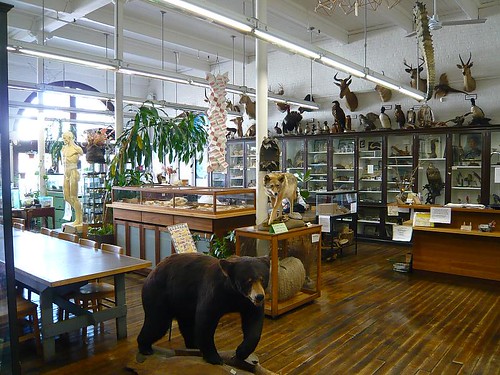 While the Nature Lab does admit the general public, the majority of users (as opposed to visitors) are RISD students and the place is nearly always packed. And effortlessly- no programs, no big exhibitions, just old animal skulls and sea shells. The Lab is open late, the staff is almost entirely students, and they sometimes play music on the stereo. You don't have to sign up to use wet media, you can touch many of the specimens, and you can even check some of them out. Some of the display cases contain mini-exhibitions curated by students.
I was one of very few students who worked in the Museum and we were relegated to the roles of tour guide and intern. I would have loved to be a part of a student curator club and make my own exhibitions with works from the Museum's 8,000 piece collection. And a student docent program would provide opportunities for work-study students to interpret the pieces for fellow students and fellow artists. I understand the security issues and archival issues of loosening up the atmosphere and handling the collection more, but what use are those objects if they aren't being used to inspire the students? And who better to care for them than artists who understand the materials and have a tremendous respect the works?
I'd love to see the Museum absorb the Nature Lab or maybe the other way around. A sort of art-museum-meets-natural-history-museum-with-library-component- maybe an Art-Nature-Museum-Lab. I could definitely see myself paying for a membership to enjoy a museum that also provided a unique space for me to come and create my own work. And anyone who has created artwork in public knows that people absolutely love to see artists at work. It reminds visitors that the art they are looking at was created by a human being and it can inspire them to look at natural objects in new ways and maybe feel less intimidated by the art-making process.
I don't think that all art museums need to be Art-Nature-Museum-Labs. There's definitely a place for white-walled museums with quiet, contemplative atmospheres and I'd hate to see places like that disappear. But the RISD Art Museum has missed its mark where its younger, quirkier cousin the Nature Lab has filled a need. The Museum could really benefit from a long hard look at itself and its mission and take a few cues from the time-honored, student-approved tradition around the corner.
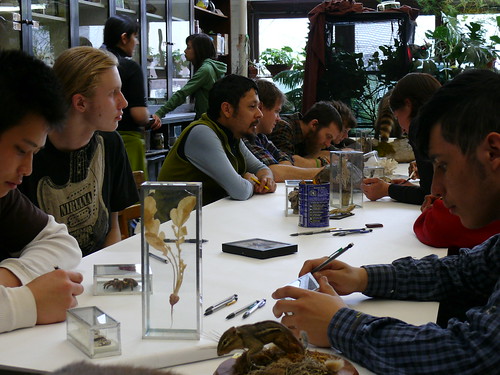
Photo credits, top to bottom: RISD Museum of Art, Frank Mullin, Flickr user onerisd, Flickr user newurbanarts
Friday, April 30, 2010
please don't blame the screens
So I'm late to this discussion- seven months to be exact. But I just had the pleasure of reading Paul Orselli's blog post in which he asked: "Are Screens Killing Museums?" On his own blog, Jim Spadaccini answered the question with: "'Screens' aren't Killing Museums". If you haven't read these posts, here are the Cliffs Notes: Paul had offered a 10-point "Screed Against Screens" and Jim responded with a point-by-point rebuttal. Paul argued that screens encourage cheesy, lazy design that antisocially sucks visitors in and the resultant experiences are inevitably disappointing. Jim countered that screens can offer more dynamic signage, track user data, and extend the visitor experience beyond the museum through the web and mobile devices.
I think Paul and Jim are both right in their premises and that's because they're not talking about the same thing. Paul talks about screens as they usually are: uninspiring experiences, usually dull and predictable and oftentimes broken. And Jim talks about screens as they could be: dynamic, engaging ways to show information, gather data, and link an exhibit to the web.
I agree that screens in exhibits often look unfortunate and screens have a lot more potential than what we see in most museums. However, I disagree that either premise supports there being more or fewer screens in museum exhibits. It's not whether we use a screen or not, it's how we use the screen.
We've all seen unfortunate museum screens like the ones Paul describes. Staring back at us with blank looks, unresponsive to our button-pressing or touch-screen prodding. Offering experiences that could be achieved with a printed interpretation panel that would have been easier for the whole family to read simultaneously. Looping video with irritating sound tracks, starring over-the-top amateur actors. You know the screens I'm talking about. To interact with one of those screens can feel like being cheated or it can even be sad or embarrassing. But it's not the screen's fault for being such an unfortunate part of the exhibit. Don't blame the screen.
Screens need to be considered alongside the wide variety of other interpretive methods available to us and implemented not because the screen itself would enhance the exhibit, but because the content begs a screen.
Screens have the potential to be the dynamic, engaging experiences Jim describes. And it's every once in a while that I'm reminded of this potential when I see a screen being used in a really smart way. Since you may have never seen a well-used screen in a museum exhibit, I'll give an example. It's from the Natural History Museum of LA County's Visible Vault, an exhibit showcasing the museum's collections of ancient Latin American art where visitors can get closer looks at particular objects from the collection, choosing from photographs presented on a (multi?) touch-screen. The screen is large enough to accommodate several viewers at a time and its black background and muted colors don't visually intrude on the quiet, reverent atmosphere of the darkened exhibition room. The experience of scrolling through objects and choosing a few to study more in-depth fits right in with the experience of exploring the dramatically-lit vault of items that appear to be in storage. This screen is effective for two reasons: it complements the rest of the exhibit experience and it offers a unique way of viewing the objects not possible with printed labels.
This idea of the "appropriate" use of technology was the focus of one of the best sessions I attended at the CAM conference in March. It was Technology: Blinded by the Light, hosted by Jonathan Katz, Kristina White, and Nina Simon. Something that was said there really applies here: "Just because I have a hammer doesn't mean I'm a carpenter." And while the hammer is a great choice for pounding nails, the saw is a better option for cutting a piece of wood. The screen is a tool and just like any other tool, it doesn't do the job by itself and it has its strengths and weakness. The key is to recognize those strengths and weakness (and our own strengths and weaknesses) and implement screens accordingly.
We don't blame hammers for our lack of carpentry skills, let's not blame screens for bad exhibit experiences.
If you haven't already, please go read the posts by Paul and Jim on their respective blogs.
I think Paul and Jim are both right in their premises and that's because they're not talking about the same thing. Paul talks about screens as they usually are: uninspiring experiences, usually dull and predictable and oftentimes broken. And Jim talks about screens as they could be: dynamic, engaging ways to show information, gather data, and link an exhibit to the web.
I agree that screens in exhibits often look unfortunate and screens have a lot more potential than what we see in most museums. However, I disagree that either premise supports there being more or fewer screens in museum exhibits. It's not whether we use a screen or not, it's how we use the screen.
We've all seen unfortunate museum screens like the ones Paul describes. Staring back at us with blank looks, unresponsive to our button-pressing or touch-screen prodding. Offering experiences that could be achieved with a printed interpretation panel that would have been easier for the whole family to read simultaneously. Looping video with irritating sound tracks, starring over-the-top amateur actors. You know the screens I'm talking about. To interact with one of those screens can feel like being cheated or it can even be sad or embarrassing. But it's not the screen's fault for being such an unfortunate part of the exhibit. Don't blame the screen.
Screens need to be considered alongside the wide variety of other interpretive methods available to us and implemented not because the screen itself would enhance the exhibit, but because the content begs a screen.
Screens have the potential to be the dynamic, engaging experiences Jim describes. And it's every once in a while that I'm reminded of this potential when I see a screen being used in a really smart way. Since you may have never seen a well-used screen in a museum exhibit, I'll give an example. It's from the Natural History Museum of LA County's Visible Vault, an exhibit showcasing the museum's collections of ancient Latin American art where visitors can get closer looks at particular objects from the collection, choosing from photographs presented on a (multi?) touch-screen. The screen is large enough to accommodate several viewers at a time and its black background and muted colors don't visually intrude on the quiet, reverent atmosphere of the darkened exhibition room. The experience of scrolling through objects and choosing a few to study more in-depth fits right in with the experience of exploring the dramatically-lit vault of items that appear to be in storage. This screen is effective for two reasons: it complements the rest of the exhibit experience and it offers a unique way of viewing the objects not possible with printed labels.
This idea of the "appropriate" use of technology was the focus of one of the best sessions I attended at the CAM conference in March. It was Technology: Blinded by the Light, hosted by Jonathan Katz, Kristina White, and Nina Simon. Something that was said there really applies here: "Just because I have a hammer doesn't mean I'm a carpenter." And while the hammer is a great choice for pounding nails, the saw is a better option for cutting a piece of wood. The screen is a tool and just like any other tool, it doesn't do the job by itself and it has its strengths and weakness. The key is to recognize those strengths and weakness (and our own strengths and weaknesses) and implement screens accordingly.
We don't blame hammers for our lack of carpentry skills, let's not blame screens for bad exhibit experiences.
If you haven't already, please go read the posts by Paul and Jim on their respective blogs.
Sunday, March 7, 2010
the value of conference

One of the best ways to find out what exciting things museums are doing is to attend a conference, and my experience this past week at the 2010 California Association of Museums Conference in San Jose really got me thinking about the way museums share their expertise. Something that was asked in a number of sessions I attended at the conference was, “Where can I read about other museums’ experiences with this problem I’m having?” Wow. Good question.
I recommended checking out the Association of Science-Technology Centers, which aims to meet this need in two ways. One is ExhibitFiles, a site that provides a space for exhibit designers and developers to share reviews and case studies, but lacks a forum. The other is the ASTC listserv which can operate as an exhibit troubleshooting forum, but whose activity is not easily accessed online for non-subscribers. These otherwise incredible resources are further limited by their focus on science centers and folks who want to make the member/subscription commitment. What if I am a curator at a small art museum and I’m having trouble creating meaningful web content for my show of 19th century silver? What I’d really want is to pose my questions on a forum for museums of all kinds that welcomes the input of anyone- museum professionals and visitors alike. What I don’t want is to commit to an entire website or listserv. It seems simple, but why is it so hard to find? One answer might be in the historically guarded institutional culture of museums.
In my work with several museums, I’ve experienced a phenomenon in which institutions fiercely guard their ideas and methods from other institutions. I think that much of that thought process comes from a feeling of competition between museums and I believe that that owes itself partially to the non-profit scramble for funding we all face. But our ever-present financial worries might be the same reason we send delegates to conferences like the one in San Jose. At a conference or an online forum, the currency we trade in is ideas, not cash. The more we share, the more dialogue we stir, and the more ideas we get to go home with. Museums are the most successful when they are innovators with unique offerings. And we can become unique and innovative if we listen to one another, share what we’ve learned, learn from others’ mistakes, and continue to be inspired by one another.
Tuesday, February 2, 2010
discovering the bay area discovery museum
Two weeks ago I visited the Bay Area Discovery Museum on a chilly, rainy day. The museum is made up of many small buildings and is well known for its outdoor playspaces, all within full, breathtaking view of the Golden Gate Bridge. Having forgotten my umbrella, I focused on indoor exhibits and caught glimpses of The Bridge through the rain.
Because the museum is just as much about the indoor exhibits as it about the grounds, the museum doesn’t seem to experience the rainy-day influx that other museums do. Even though the museum wasn’t packed, I had a great time watching the few families that were there enjoying the exhibits. Each exhibit space is small and set apart from the others, so exhibits are quieter and inspire a more contemplative kind of play than some of the larger museums I’ve visited. Exhibits were full of tubes of seashore artifacts to examine, tunnels to explore, glass walls to paint on, and beautiful costumes to wear. These are examples of the open-ended kinds of play that encourage creativity. For the museum’s philosophy on nurturing childhood creativity, check out their website.
The traveling exhibit in Discovery Hall, Animal Secrets, was all about animal habitats. Something I appreciated about this exhibit was the care that was taken to actively include caregivers in their children’s play.
Some signage spoke to families directly:
The tone was encouraging:
And sometimes the invitation was more subtle:

In this last instance, the chipmunk costumes came in adult sizes, so grown-up chipmunks could join their little chipmunks gathering acorns and storing them in a big hollow tree. I couldn’t help but smile to see a boy and his parents exploring the exhibit hall, all wearing matching chipmunk vests with tails.
Museums like the Bay Area Discovery Museum know the importance of a grown-up’s involvement in their child’s play, but they also know how important it is for that play to be child-directed. It’s a difficult balance to strike. Offering open-ended activities like exploring a cave or following animal tracks are less likely to encourage parental take-over and prompts like the above examples reassure parents that they’re welcome.
As much as I enjoyed each exhibit hall, I stayed in Tot Spot the longest. Specifically for infants and toddlers, it was the most popular exhibit hall that rainy weekday afternoon. I sat on one of three vinyl waterbed ponds under a tank full of goldfish with a family of four. We counted the fish, jumped on the waterbed, and played with big green vinyl lily pads. There were lots of fun costumes to wear, structures to climb over, under, and through, and lots of fun textures to experience.
The next sunny day I have available to me, I’ll be going back to the Bay Area Discovery Museum to check out all the outdoor playspaces. I’m looking forward to it!
Because the museum is just as much about the indoor exhibits as it about the grounds, the museum doesn’t seem to experience the rainy-day influx that other museums do. Even though the museum wasn’t packed, I had a great time watching the few families that were there enjoying the exhibits. Each exhibit space is small and set apart from the others, so exhibits are quieter and inspire a more contemplative kind of play than some of the larger museums I’ve visited. Exhibits were full of tubes of seashore artifacts to examine, tunnels to explore, glass walls to paint on, and beautiful costumes to wear. These are examples of the open-ended kinds of play that encourage creativity. For the museum’s philosophy on nurturing childhood creativity, check out their website.
The traveling exhibit in Discovery Hall, Animal Secrets, was all about animal habitats. Something I appreciated about this exhibit was the care that was taken to actively include caregivers in their children’s play.
Some signage spoke to families directly:
The tone was encouraging:
And sometimes the invitation was more subtle:
In this last instance, the chipmunk costumes came in adult sizes, so grown-up chipmunks could join their little chipmunks gathering acorns and storing them in a big hollow tree. I couldn’t help but smile to see a boy and his parents exploring the exhibit hall, all wearing matching chipmunk vests with tails.
Museums like the Bay Area Discovery Museum know the importance of a grown-up’s involvement in their child’s play, but they also know how important it is for that play to be child-directed. It’s a difficult balance to strike. Offering open-ended activities like exploring a cave or following animal tracks are less likely to encourage parental take-over and prompts like the above examples reassure parents that they’re welcome.
As much as I enjoyed each exhibit hall, I stayed in Tot Spot the longest. Specifically for infants and toddlers, it was the most popular exhibit hall that rainy weekday afternoon. I sat on one of three vinyl waterbed ponds under a tank full of goldfish with a family of four. We counted the fish, jumped on the waterbed, and played with big green vinyl lily pads. There were lots of fun costumes to wear, structures to climb over, under, and through, and lots of fun textures to experience.
The next sunny day I have available to me, I’ll be going back to the Bay Area Discovery Museum to check out all the outdoor playspaces. I’m looking forward to it!
Wednesday, January 20, 2010
dinner, a movie and the universe
There are few things more romantic than stargazing and going to science museums, so when I heard about Dinner, a Movie, the Universe at Chabot Space and Science Center, making a reservation was a no-brainer.
 My Dinner-Movie-Universe date took place last Friday. I’d never been to Chabot, so imagine what a great introduction I got, driving up into the Oakland Hills at night, glimpsing breathtaking views of the city from Skyline Boulevard.
Dinner
We started our evening with dinner in the Celestial Café. First came bruschetta, then a fresh salad, followed by our choice of entrée. I’d opted for the risotto, it being the vegetarian option, and it was the only real disappointment of the evening. I’m usually a very good eater and I couldn’t finish mine despite my healthy appetite. Thankfully the apple crisp I had for dessert was tasty and filling. Our shows didn’t start until later, so we had a little time to explore the exhibit Beyond Blastoff, which I’ll write about next week.
A Movie
From a choice of four presentations, my date and I decided on two planetarium shows to see: Immersive Space and Tales of the Maya Skies. Immersive Space was a guided tour of the universe, focusing on several audience-requested destinations. Our tour guide of the cosmos was accommodating and easy to understand without talking down to us. As a former museum tour guide I know what a hard line it is to toe- I admire folks who do it well. I also appreciated how he acknowledged light pollution as a problem for stargazers, but focused on what one can see from the Oakland Hills and how easy it is to travel to see darker skies. We began with a view from Chabot, as if the dome of the planetarium had been lifted and we were looking up at the night sky. We then explored the Milky Way, Neptune’s moons, and the Orion Nebula. The images were created using a combination of photographs and CGI for a rich, visually dazzling display.
Our next show was very different. I had wanted to see Tales of the Maya Skies because of how fascinated I am by the ancient Mayan civilization. The film detailed the advanced astronomical discoveries of the Maya and the importance of the movement of celestial bodies in Mayan culture. With sweeping views of theatrically lit 3D models of colorful temples and artistic visualizations of Mayan mythology, the show was visually captivating. Yet I left the screening unable to put my finger on exactly what had turned me off about it.
While enthusiasm is important in engaging an audience, I often find that over-enthusiasm can spoil a moment for me. As narrator Lila Downs spoke dramatically about her ancestors, I had trouble sharing her delight. The tone of her voice communicated so strongly a sense of reverence for the Mayan culture, it felt a little propaganda-like and I couldn’t help but be skeptical. If the Maya are so cool, I thought, Why all the hype? The stories she was telling were so fascinating and the visuals so engaging, I didn’t need the extra excitement- I didn’t need convincing.
A few days later I found this video on KQED.org and gained a deeper appreciation for this film and the technology used to create it. I’m especially intrigued by Chabot's collaboration with CyArk, a nonprofit using laser-scanning technology to create visual records of cultural heritage sites.
The Universe
The only thing we missed out on was the Universe portion of our evening. The overcast skies didn’t bode well for a look through the telescopes of the observatory. More incentive for a return visit!
* * *
Nighttime events are exciting, unique opportunities for visitors and are effective ways for museums to extend their hours and audience. Dinner, a Movie and the Universe seems to me a very successful take on this concept and since the dinner selections, films, and night sky are in constant rotation, it seems a sustainable one too.
 My Dinner-Movie-Universe date took place last Friday. I’d never been to Chabot, so imagine what a great introduction I got, driving up into the Oakland Hills at night, glimpsing breathtaking views of the city from Skyline Boulevard.
Dinner
We started our evening with dinner in the Celestial Café. First came bruschetta, then a fresh salad, followed by our choice of entrée. I’d opted for the risotto, it being the vegetarian option, and it was the only real disappointment of the evening. I’m usually a very good eater and I couldn’t finish mine despite my healthy appetite. Thankfully the apple crisp I had for dessert was tasty and filling. Our shows didn’t start until later, so we had a little time to explore the exhibit Beyond Blastoff, which I’ll write about next week.
A Movie
From a choice of four presentations, my date and I decided on two planetarium shows to see: Immersive Space and Tales of the Maya Skies. Immersive Space was a guided tour of the universe, focusing on several audience-requested destinations. Our tour guide of the cosmos was accommodating and easy to understand without talking down to us. As a former museum tour guide I know what a hard line it is to toe- I admire folks who do it well. I also appreciated how he acknowledged light pollution as a problem for stargazers, but focused on what one can see from the Oakland Hills and how easy it is to travel to see darker skies. We began with a view from Chabot, as if the dome of the planetarium had been lifted and we were looking up at the night sky. We then explored the Milky Way, Neptune’s moons, and the Orion Nebula. The images were created using a combination of photographs and CGI for a rich, visually dazzling display.
Our next show was very different. I had wanted to see Tales of the Maya Skies because of how fascinated I am by the ancient Mayan civilization. The film detailed the advanced astronomical discoveries of the Maya and the importance of the movement of celestial bodies in Mayan culture. With sweeping views of theatrically lit 3D models of colorful temples and artistic visualizations of Mayan mythology, the show was visually captivating. Yet I left the screening unable to put my finger on exactly what had turned me off about it.
While enthusiasm is important in engaging an audience, I often find that over-enthusiasm can spoil a moment for me. As narrator Lila Downs spoke dramatically about her ancestors, I had trouble sharing her delight. The tone of her voice communicated so strongly a sense of reverence for the Mayan culture, it felt a little propaganda-like and I couldn’t help but be skeptical. If the Maya are so cool, I thought, Why all the hype? The stories she was telling were so fascinating and the visuals so engaging, I didn’t need the extra excitement- I didn’t need convincing.
A few days later I found this video on KQED.org and gained a deeper appreciation for this film and the technology used to create it. I’m especially intrigued by Chabot's collaboration with CyArk, a nonprofit using laser-scanning technology to create visual records of cultural heritage sites.
The Universe
The only thing we missed out on was the Universe portion of our evening. The overcast skies didn’t bode well for a look through the telescopes of the observatory. More incentive for a return visit!
* * *
Nighttime events are exciting, unique opportunities for visitors and are effective ways for museums to extend their hours and audience. Dinner, a Movie and the Universe seems to me a very successful take on this concept and since the dinner selections, films, and night sky are in constant rotation, it seems a sustainable one too.


